304 vs. 316 Stainless Steel for Food Equipment: How to Choose
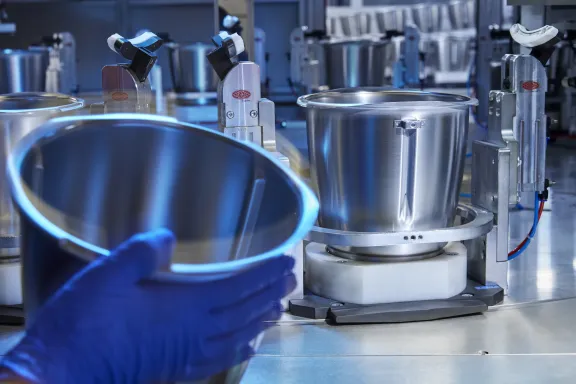
Side by side, a component made from AISI 304 and one made from AISI 316 look identical. The difference shows up only after months in service, once the surface has been exposed to salt, acids, steam, and sanitizers. That is when you find out whether the alloy was the right choice.
For engineers designing professional food equipment, choosing between 304 and 316 stainless steel means balancing corrosion resistance, cost, and workability for each component, not for the machine as a whole. This article covers the technical criteria behind that choice, from what sets the two alloys apart to how fabrication affects their real-world performance.
What Is the Difference Between 304 and 316 Stainless Steel?
AISI 304 and AISI 316 belong to the same family, the chromium-nickel austenitic stainless steels, and both are approved for food contact. 304 is the most widely used austenitic stainless steel. On average it contains 18% chromium, 8–10% nickel, and less than 0.07% carbon. It was once known as 18/8, a mark still found stamped on older flatware and housewares. 316 adds roughly 2–3% molybdenum and has a higher nickel content.
Molybdenum is what makes the difference. It reinforces the passive chromium oxide layer exactly where that layer is most vulnerable, in the presence of chlorides, and increases resistance to pitting and crevice corrosion. A common way to compare corrosion resistance across stainless steel grades is PREN (Pitting Resistance Equivalent Number), which weights specific alloying elements by their percentage. AISI 304 has a PREN of around 19, while AISI 316 reaches about 24.
In typical compositions, 304 contains slightly more chromium than 316, but 316 has more nickel and, more importantly, contains molybdenum. The two therefore perform differently in the field. 304 holds up well in low-salinity environments, while 316 stays protected even in contact with salt and chlorinated sanitizers. Both alloys are also available in low-carbon versions, 304L and 316L, designed for welded components.
In fabrication, the two alloys behave in much the same way. Both are well suited to deep drawing, bending, and welding, so the choice almost always comes down to two factors: the environment the component will operate in, and cost.
What Puts Stainless Steel to the Test in Food Equipment
Stainless steel is not immune to corrosion. It resists only as long as its passive layer stays intact. In professional food equipment, four factors work against it, and they rarely act one at a time.
The first is chlorides. Salt, brines, sauces, cheese, seafood, and some detergents bring chlorides into contact with the surface, where small electrochemical corrosion pits can form. The second is the acidity of many foods, from tomatoes to citrus to vinegar, which makes the environment more aggressive, especially with prolonged contact.
The third factor is temperature. Cooking, hot holding, and high-temperature washing accelerate corrosion that chlorides and acids have already started. The fourth is sanitation: alkaline detergents and, in some cases, chlorinated disinfectants applied daily for years.
In these cases, always follow detergent washing with a thorough rinse under running water.
One more condition amplifies all the others: stagnation. Wherever liquids and residues stand still, such as in a crevice, under a sheet metal overlap, or in a corner that does not drain, oxygen is depleted and the passive layer weakens. That is where an alloy that looks right on paper can still fail.
When 304 Is Enough and When You Need 316
The practical rule is to assess the exposure of each component, not of the machine as a whole. A single unit can combine 304 and 316 parts, each matched to the conditions it faces.
For components with indirect food contact, such as housings, panels, frames, and covers, AISI 304 is the standard choice. These parts typically operate in a dry environment and only need routine cleaning. 304 is also the right fit for work surfaces and tanks that handle mildly aggressive products, where contact is direct but salinity is low and washing is regular.
AISI 316 becomes the appropriate grade when exposure is more severe. This applies to tanks and containers for brines, sauces, seafood, or dairy products, which are in prolonged contact with chlorides and acids. It also applies to hot zones in contact with liquids, where high temperatures, condensation, and possible stagnation combine. The same goes for surfaces that are frequently sanitized with chlorinated products and face repeated chemical exposure.
Heavily welded components call for a separate assessment, because they carry a risk of corrosion in the heat-affected zone. For these parts, the low-carbon grades, 304L or 316L, are the recommended choice.
These low-carbon grades deserve a closer look. During welding, and during any heat treatment between 450 and 850 °C (840–1560 °F), carbon bonds with chromium along the grain boundaries, drawing chromium away from the passive chromium oxide layer. The phenomenon is called sensitization, and it opens the door to intergranular corrosion. Lower carbon content reduces the risk, which is why L (low-carbon) grades are a common choice for components with continuous welds, including multi-pass welds.
304 remains the most widely used and most cost-effective option, and it is the right choice for a very broad range of applications. 316 is not a "better 304" to specify everywhere just to be safe. It is a targeted answer to chlorides, acids, and heat, and it makes sense where those conditions are actually present. Ferritic stainless steels are another option: nickel-free grades with a ferritic, and therefore magnetic, structure, such as AISI 430, 441, and 444. The regulatory framework and typical applications for these grades are covered in our article on MOCA and food-grade sheet metal.
The Alloy Is Not Enough: How Fabrication Determines Corrosion Resistance
A poorly fabricated, poorly finished 316 component can corrode sooner than a well-fabricated, well-finished 304 component. The alloy sets the ceiling for corrosion resistance. Geometry, welds, and finishing determine how much of it survives in service. That is why material selection and the production cycle should be decided together.
Geometry comes first. With deep drawing, a tank or container is formed from a single sheet metal blank. It has no joints, and therefore no crevices where liquids and residues can collect. The process is explained in detail in our guide to metal deep drawing.
When a joint is unavoidable, technique matters. A continuous weld seam eliminates the gaps left by spot or intermittent welding. Laser welding produces that seam with very low heat input, which limits changes to the material around the joint. The main welding processes are compared in our article on the most widely used welding technologies, and the technologies available at Minifaber are outlined on our metal welding page.
Welding generates various oxides, especially when no shielding gas is used. These include heat tint along the weld edges, which discolors the base metal. These oxides weaken the corrosion resistance of the metal, and the finishing cycle is designed to remove them. Degreasing and pickling remove the oxide, and passivation restores the chromium oxide layer. Finally, polishing improves the appearance of the weld and makes it easier to clean, which further increases its corrosion resistance.
Minifaber manages this entire surface treatment cycle and entrusts the chemical treatments to specialized partners.
One last concern is contamination. Carbon steel particles left behind by tools or work surfaces can settle on stainless steel and turn into rust spots. These spots look like a material defect, but they originate in the process. That is why, in stainless steel fabrication, Minifaber controls the entire cycle and keeps every source of contamination away from the material.
Why Cleaning Matters
Clean surfaces are essential to prevent stainless steel from corroding because of contaminants of all kinds.
Cleaning starts during production. If the material comes into contact with lubricants, such as deep drawing oils, they must be removed as soon as possible after processing, because they can trigger corrosion or weaken the chromium oxide layer. Surfaces must also be cleared of the dust generated in production areas, which often contains metal particles such as iron that can start corrosion. Airborne dust from outside, made up of pollutants and organic matter, can also cause corrosion if it is not removed. If a stainless steel part has to be stored outdoors for an extended period, it should be protected.
Cleaning does not end with fabrication. Throughout the equipment's service life, stainless steel parts must be kept consistently clean, with free access to air and no standing liquids, so that they maintain their corrosion resistance.
How Minifaber Supports Material Selection in Food Equipment Professional Projects
The choice between 304 and 316 is best made while the design is still open, when thicknesses, geometries, and fabrication cycles can still change at no extra cost.
Minifaber first agrees on the material with the customer. Where needed, it also defines how to split the assembly into individual parts that are then welded back together, which sets the production cycle. At that point, Minifaber's engineering department designs the tooling for deep drawing, 3D laser cutting, and welding. When required, Minifaber also produces samples, including on faster cycles, giving the customer the prototypes needed to fully define and validate the project.
This way, stamping and welding issues come to light while they can still be addressed.
In production, Minifaber acts as a single-source partner, from individual parts to assembled subsystems. Customers get one point of contact and a single documentation trail, from alloy selection to final finishing.
Frequently Asked Questions About 304 and 316 Stainless Steel
Is 304 stainless steel food grade?
Yes. AISI 304 is the most widely used stainless steel in the food industry and is suitable for food contact in the vast majority of applications. 316 becomes the better choice for salty or acidic foods, high temperatures, and aggressive sanitizing.
What is 18/10 stainless steel?
It is an older name, still in use, for an austenitic stainless steel with about 18% chromium and 10% nickel, which corresponds to AISI 304. The 18/8 mark refers to the same family with a lower nickel content.
How can you tell 304 from 316?
Not by eye. The reliable method is the material certificate (mill test report), which shows the chemical composition of the heat. Other options are chemical reagents that detect molybdenum and handheld X-ray fluorescence (XRF) analyzers that read the chemical composition of the material.