Sheet Metal Cutting: Laser Cutting: Laser Cutting, Blanking, or CNC Punching? A Selection Guide
Laser cutting, blanking, or CNC punching? Compare the three sheet metal cutting methods by part geometry, production volume, and design flexibility.
Anyone who needs to make a sheet metal component usually ends up weighing three different technologies: laser cutting,blanking, and CNC punching.
They’re often presented as interchangeable ways to cut and open up sheet metal, but they are distinct processes, each with its own strengths.
Laser cutting separates the material thermally. Blanking, by contrast, is a mechanical process: the part is produced in a single press stroke, using a die built specifically for that one component. CNC punching also has its own characteristics. It rests on the same shearing principle as blanking, working through localized deformation and material removal, but it uses standard tools that can be reused across many parts. There is no dedicated die. Instead, the punch press works in sequence to create holes, slots, and complex profiles on flat sheets.
That’s why a side-by-side comparison is useful. The right choice depends on several factors working together, chiefly part geometry and production volume.
Laser Cutting: Flexibility Without Tooling
Laser cutting is a thermal separation process. A laser beam focused on the sheet, right along the cutting path, locally melts the material along the required profile. At the same time, a jet of assist gas (oxygen or nitrogen) blows the molten material out of the kerf, so no physical tool ever touches the sheet. That is also its main strength. Because it isn’t tied to a die or a dedicated tool, a laser can cut virtually any geometry straight from the part drawing, and the profile can change from one part to the next with no tooling or setup costs.
It’s the best choice when a project is still at the prototyping stage, when you’re running small to medium batches, when geometries are complex, variable, or non-repeating, and when you want clean cut edges even on intricate shapes.
One thing to keep in mind: laser cutting is a continuous process that follows the profile. On highly repetitive geometries, large production runs, or straight-line profiles, cycle time can be less competitive than a process that makes the same cut in a single stroke, like blanking, or in several strokes, like punching.
Minifaber laser-cuts carbon steel, stainless steel, and aluminum using CO2 lasers. Its machine fleet includes four combination punching and laser cutting machines that can handle sheets up to 1,250 x 2,500 mm (about 49 x 98 in.).
Copper is also processed, but it is cut with a fiber laser, whose wavelength is about 10 times shorter than that of a CO2 laser. Minifaber runs fiber laser cutting on two work cells that can cut and weld 3D profiles as well as flat sheets. They can also handle parts that have already been through deep forming operations such as deep drawing and hydroforming. This type of laser can cut all of the metals listed above.
Blanking: Speed and Cost Efficiency on Large Runs
Blanking is a cold shearing process that separates the part from the sheet. Technically, the operation is called blanking when you cut a closed part out of the sheet, and piercing when you make holes or openings inside the part.
The active components are the punch and the die, which shear the sheet, and the stripper plate, which does several jobs. It holds the sheet down at the edges while the punch penetrates the material, guides slender punches to prevent buckling, and keeps the sheet in place during the punch’s return stroke, since the material tends to cling to the punch and would otherwise be lifted with it.
Unlike punching, which works on flat sheets with standard tools, blanking typically starts from coil stock, strips, or precut blanks. A sheared edge has a characteristic profile: a small rollover radius at the punch entry, followed by a smooth burnished (sheared) zone, a fracture zone, and a burr on the exit side. How pronounced each of these is depends on material hardness, thickness, and punch-to-die clearance.
It’s also worth noting that the size of a sheared hole varies through the thickness of the material. Across the sheared portion, starting at the punch entry side, the hole matches the punch size. From the point where the fracture zone begins to the exit on the opposite side, the dimension gradually shifts toward the die size, which is larger than the entry size. The nominal size of a pierced hole is the entry size, that is, the punch dimension.
Depending on part complexity, a blanking die can be one of four types:
- Simple die: one operation per press stroke.
- Compound die: several operations in the same stroke, such as blanking, bending, and drawing.
- Progressive die: the strip advances through multiple stations until the finished part comes out, which is ideal for high-volume, high-productivity runs.
- Transfer die: the blank is separated from the strip right away and moved between stations by a device called a transfer, which is ideal for parts with deep draws.
That makes blanking the best fit for medium-to-high production volumes that justify the investment in a dedicated die, for parts with a stable geometry that won’t need frequent design changes, and for jobs that demand maximum speed on large quantities, where the cost per part drops sharply as the run size grows.
The flip side is rigidity. In most cases, any change to the drawing means modifying the die or building a new one, with the associated tooling costs and lead time. That’s why blanking isn’t the most efficient solution for prototyping or for projects whose geometry may still evolve.
CNC Punching: The Middle Ground Between Flexibility and Speed
CNC punching is a cut made locally on the sheet by a standard tool, driven by the operating unit that moves the tool, also known as the punch head. The combined action of the punch head and the movement of the sheet between strokes produces the profile specified in the drawing. A punch press can therefore create openings in multiple strokes according to the programmed drawing. It can also produce single holes with the precision of a blanking die, along with small forming operations such as louvers, embossments, extruded holes, lances, and even tapped threads.
Each tool has its own dimensions. Tools are generally either standard or special-shaped, though even the special ones are mounted in standard tool holders. A processing program selects the appropriate tool for each operation, and nesting software optimizes sheet processing and raw material usage.
The geometry of a punched hole is similar to that of a blanked one: a rollover radius at the sheet entry, a sheared zone, a fracture zone, and finally a burr on the exit side.
CNC punching is especially effective when a job calls for numerous holes, slots, or repeated shapes on the same sheet, when volumes don’t yet justify a dedicated die but speed on repetitive hole patterns still matters. It’s also a good fit when the design may still change, since updating the machine program is all it takes to accommodate a new drawing revision.
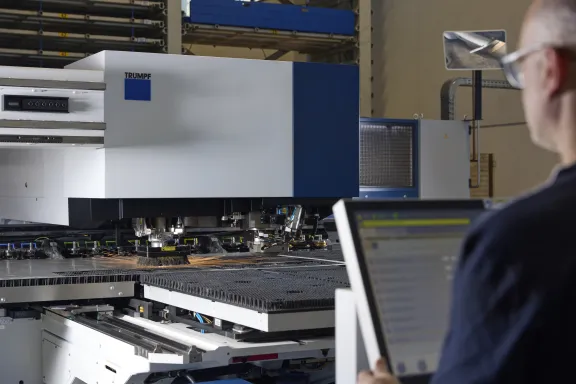
Minifaber has four combination laser cutting and punching machines, which bring the strengths of both technologies together in a single machine.
How to Choose Between Laser Cutting, Blanking, and CNC Punching
When you compare the three technologies, the decision comes down to three questions to ask before production starts:
- What type of geometry do you need? Repeated holes and slots on the same sheet point toward punching. External profiles and repeated shapes in large lots point toward blanking. Complex, variable, or not-yet-final shapes point toward laser cutting.
- What are your production volumes? For prototyping and small to medium runs, laser cutting and CNC punching are the most flexible and cost-effective options, with no dedicated die to pay for. For medium-to-high volumes that stay stable over time, blanking becomes the most economical choice in the long run.
- Is the design final, or could it still change? If the drawing may still be revised, laser cutting and CNC punching can adapt without a new die, whereas blanking requires a geometry that is already locked in.
Combined Technologies: The Advantage of Integration
In practice, the choice isn’t always either/or. Many components need more than one process in the same production cycle. Minifaber uses machines that combine punching and laser cutting, so the strengths of both processes can be applied to the same part: the precision and speed of punching on repetitive holes, together with the flexibility of laser cutting on more complex or variable geometries. This integrated approach optimizes quality and cost at the same time, without forcing you to pick a single technology for the entire component.
For a technical assessment of your specific project, the Minifaber team is ready to help you identify the best combination of processes.
Minifaber is your partner for sheet metal fabrication and finished products