Stainless Steel Medical Components: Materials, Cleaning and Sterilization
A sheet metal component built for a medical device spends its life exposed to detergents, disinfectants and, often, pressurized steam cycles. That's why the alloy is only the starting point when you design stainless steel medical components. What matters even more is how the part will behave after hundreds of washes and sterilization cycles.
Material, geometry, welds and surface finish all work toward the same result: a surface that cleans thoroughly and doesn't corrode. In this article, Minifaber walks through the technical criteria that guide how stainless steel is selected and processed for the medical industry, from alloy to final treatment.
Why Stainless Steel Is the Go-To Material in the Medical Industry
Stainless steel gets its corrosion resistance from an extremely thin, extremely tough surface film of chromium oxide, known as the passive layer. If this layer is damaged, it can regenerate itself in an oxidizing environment. For that to happen, surfaces have to be smooth, clean, free of contaminants and free of stagnant areas.
In a hospital setting, this property is extremely important, and it comes with three others:
- stainless steel has a dense, non-porous surface, so it doesn't retain organic residue
- the material withstands steam sterilization temperatures
- stainless steel lends itself to cold forming, allowing deep draws and bends with a controlled radius
Austenitic stainless steels are the most widely used family for medical sheet metal parts, housings, chambers and assemblies. Other stainless steel families have other uses because of their properties. Martensitic grades like AISI 420 are used for tools because of their hardness. Ferritic grades like AISI 430, 441 and 444 have a wide range of uses: in boilers, where they offer high corrosion resistance at high temperatures, and in appliances, housewares and kitchen robotics, where a magnetic material is required.
AISI 304 or AISI 316: How to Choose the Alloy for Medical Components
AISI 304 and AISI 316 are both austenitic chromium-nickel steels. The main difference is molybdenum. 316 contains 2–3% of it, which increases corrosion resistance in the presence of chlorides. Chlorides cause several forms of corrosion, particularly pitting, crevice corrosion and stress corrosion cracking.
This detail matters, because there's no shortage of chlorides in the medical field. They're found in hypochlorite-based disinfectants, saline solutions, bodily fluids and residue from the water used to generate steam. That's why 316 tends to be preferred for wetted parts and for surfaces exposed to the harshest cleaning agents. 304 remains a solid choice for enclosures, frames and parts with indirect contact.
In practice, 304 forms very well and is typically used for housings, frames and panels. 316 is used for chambers, tanks and any part that stays in contact with chlorinated fluids or disinfectants. Then there are 304L and 316L, which contain less carbon: 0.03% max, compared with 0.08% for the standard grades.
The low-carbon grades, 304L and 316L, come into play when a component requires continuous welds. During welding, within the sensitization temperature range, carbon tends to bond with chromium at the grain boundaries. This draws chromium away from the chromium oxide that forms the passive layer and leads to intergranular corrosion. With less carbon, the effect is reduced.
Not everything has to be stainless steel, though. A single assembly can combine different materials, and the basic rule is simple: stainless steel goes wherever the surface meets steam, fluids or cleaning agents. The sterilizer Minifaber manufactured, for example, combines AISI 304/316, ferrous materials (including coated ones) and other alloys.
Minifaber works with austenitic stainless steels, AISI 304 and 316, and defines the best alloy with the customer during the co-design phase. All materials are carefully traced: Minifaber keeps the mill certificates and periodically verifies chemical and mechanical properties through laboratory testing.
Designing for Cleanability: Geometry, Bends and Welds
To preserve the corrosion resistance of an austenitic stainless steel component, the material surface has to be smooth, free of crevices and sharp corners, and easy to clean. Crevices and sharp corners can't be cleaned properly. Organic and metallic impurities build up there and weaken the passive layer, which is already sitting in a poorly oxygenated, stagnant microenvironment. These are ideal conditions for corrosion to start.
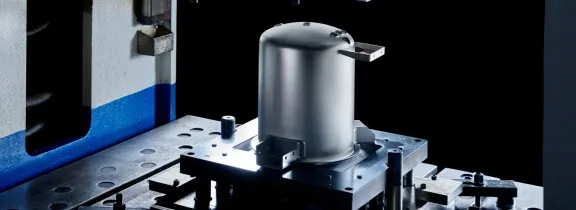
These criteria are defined at the design stage, and one of the most important is reducing joints. With deep drawing, Minifaber produces tanks, chambers and containers in one piece, starting from a disc or sheet metal blank. There are no welds, and no cracks or crevices where bacteria can collect and corrosion can start. The individual forming steps, materials and process limits are covered in detail in our guide to sheet metal deep drawing. The deep-drawn chamber is the heart of the autoclave: it's where the medical instruments are sterilized.
A sterilization chamber assembly also includes accessory components made by laser cutting, punching and bending.
Bending stainless steel and ferrous sheet metal means taking several important factors into account. The bend radius can't be too small relative to the material's thickness and hardness, or cracks will form on the outside of the bend. You also need to understand and control springback, the material's inevitable tendency to open the bend. For metal bending, Minifaber uses press brakes that hold repeatable angles even across large production runs.
Then there are the welds. An intermittent or spot weld leaves crevices between the sheets; a continuous, sealed weld bead eliminates them. Minifaber performs TIG, MIG/MAG, resistance and robotic laser welding, and certifies leak-tight welds for components with hermetic sealing requirements. Laser welding in particular produces a narrow bead with very limited thermal alteration, as explained in our comparison of MIG, TIG and laser welding.
Finally, there's a less visible risk: contamination from ferrous particles. Tools such as brushes, abrasives, clamps and press brake blades can leave residue on stainless steel surfaces and trigger corrosion. So can containers such as bins, shelves and pallets that are also used for carbon steel. The iron-rich dust that circulates in welding areas also weakens the passive film when it settles on stainless steel. That's why Minifaber manages the entire stainless steel production cycle while keeping every source of contamination away.
Surface Finishing: Washing, Pickling, Passivation and Polishing
After forming and welding, the surface carries forming lubricants, weld oxides and small particles. The finishing cycle removes them and restores the stainless steel's natural protection. Each step has a specific purpose.
Ultrasonic cleaning uses cavitation to loosen oils and residue, even in the hardest-to-reach areas. Minifaber applies it to critical surfaces to remove processing residue and prevent corrosion from starting.
Pickling removes the oxides and discoloration left by welding, along with the chromium-depleted surface layer. Passivation, which follows, promotes and stabilizes the formation of the chromium oxide layer, strengthening corrosion resistance exactly where the part is most exposed.
Polishing and electropolishing reduce roughness, and with it the micro-asperities that residue and biofilm can cling to. Electropolishing in particular removes the outermost layer of the steel, between 10 and 40 microns, which has been altered by mechanical processing. Finally, glass bead blasting evens out the surface and gives it a consistent satin finish.
The required roughness value should be defined in the specifications, based on where the component sits and the type of contact. Minifaber manages the full surface treatment cycle and relies on specialized local partners for chemical treatments such as pickling, passivation and electropolishing.
Cleaning, Disinfection and Sterilization: What a Stainless Steel Component Has to Withstand
Cleaning, disinfection and autoclave sterilization are three distinct stages in a cleaning protocol for medical instruments, each at a different level. Cleaning removes visible soil and organic residue. Disinfection reduces the microbial load. Autoclave sterilization eliminates all microorganisms, spores included. A medical component may be exposed to one, two or all three of these processes, and each one puts stainless steel to the test in a different way.
The specialized alkaline and enzymatic detergents used for cleaning are generally well tolerated by stainless steel, as long as rinsing is thorough.
Among disinfectants, chlorine-based products such as sodium hypochlorite are the most critical. Chlorides attack the passive layer and can cause pitting, especially on 304 and where crevices are present. Disinfection takes place outside the sterilization chamber, but any contaminants left on instruments, such as chlorides, have to be rinsed off immediately, because they can trigger corrosion. This matters even more if they end up inside the sterilization chamber, where they can corrode the autoclave itself.
Autoclave steam sterilization uses pressurized saturated steam, with cycles commonly run at 121 °C or 134 °C. For the component, this means repeated thermal cycling, which stresses welds and joints between dissimilar materials. It also means condensate, which can leave stains if the water contains chlorides or silicates. When the component is the chamber itself, pressure comes into play too. The chamber is a pressure vessel and must meet PED requirements and, for the American market, ASME requirements.
One point needs to be clear: validating the device's cleaning and sterilization processes is the manufacturer's responsibility. The manufacturer defines the instructions within the framework of Regulation (EU) 2017/745 (MDR). The component supplier's job is to deliver surfaces, welds and documentation consistent with those requirements. Minifaber does this with validated samples and PPAP documentation on every project before series production, and with end-to-end documented traceability from raw material supplier to delivery.
The Pressure Steam Sterilizer Case
The steam sterilizer for medical instruments project brings together everything covered so far. The sterilizer is available in 17- and 22-liter formats as well as larger sizes. The most delicate part is the deep-drawn chamber. It has to meet the technical requirements for pressure vessels under PED and ASME, with tight dimensions and tolerances, quality procedures, certification and weld inspection.
Minifaber manages the project from co-design and prototyping through die building to forming the chamber by deep drawing and stamping. Turning, threading, punching and bending for the components were added to the chamber work. So were laser, TIG and MIG/MAG welding, heat treatment, and a finishing cycle of polishing, glass bead blasting and ultrasonic cleaning. The process ends with pressure testing and all the documentation required under PPAP.
The result is a complete product, assembled and tested to PED and ASME, delivered by a single point of contact with no suppliers to coordinate.
Minifaber: One Prime Contractor for Stainless Steel Medical Components
A medical subsystem requires 6 to 8 different processes on average. When they're spread across as many suppliers, every handoff adds shipping, downtime and another point where traceability can break. Minifaber takes on this coordination by acting as prime contractor, from individual parts to finished subsystems, with a single technical and documentation contact.
A technical team of specialists from different Minifaber departments analyzes the project and proposes improvements and solutions to optimize cost, materials, thicknesses, production cycle and the quality of the final design. In a word, co-design with the customer. Next, the 10-person Engineering Department designs and builds the required tooling: from sheet metal stamping dies to fixtures for 3D laser cutting, welding and dimensional inspection.
This way, stamping and welding issues surface while they're still manageable, before the production die is machined. The method is described on our design and manufacturing page.
Behind this approach are 56,000 m² of production facilities, 373 people, a machine fleet ranging from 7-axis CNC press brakes to robotic welding cells, and €5.6 million invested in technology in 2025. The quality system is certified to UNI EN ISO 9001:2015 and UNI EN ISO 14001:2015, with ASME certification.
FAQ: Stainless Steel Medical Components
AISI 304 or AISI 316: which is better for a medical component?
It depends on exposure. Thanks to molybdenum, 316 resists chlorides better and is the right choice for wetted parts or parts cleaned with chlorinated disinfectants. Both are used for autoclaves. Because it costs less, 304 is well suited to brackets, supports, enclosures, frames and parts with indirect contact.
Can stainless steel withstand autoclave sterilization?
Yes. Austenitic stainless steels are stable and retain their mechanical and chemical properties at steam cycle temperatures, commonly 121 °C or 134 °C. How long an autoclave lasts depends on how it's built: weld quality, geometry, surface finish and cleanliness. As cycles add up over the autoclave's service life, however, chemical reactions can weaken the passive film. The quality of the water used for steam is critical. Chlorides, a pH that's too acidic or too alkaline, and mineral salts, combined with a hot, oxygen-poor environment, break down the passive film and lead to staining and corrosion.
Why does passivation matter for stainless steel medical components?
Because processing and welding weaken the chromium oxide passive layer. Pickling and passivation restore and stabilize it, reducing the risk of corrosion on the most exposed surfaces.
Who validates the sterilization process for a medical device?
The device manufacturer, within the framework of Regulation (EU) 2017/745. The component supplier has to ensure that materials, surfaces, welds and documentation are consistent with the defined requirements.