Sheet Metal Components for Coffee Machines: Between Technical Function and Stainless Steel Design
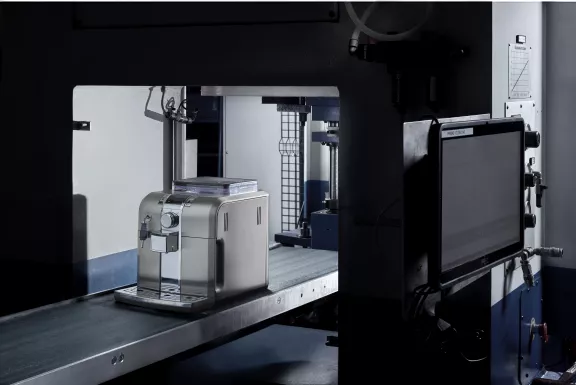
For decades, Minifaber has been a key manufacturer of sheet metal components for coffee machines, a sector where sheet metal processing must meet two very different requirements at the same time: technical performance and aesthetic quality.
On one side are the mechanical components that make the machine work, such as boilers and steam generators. On the other are the components the end customer sees and touches every day: the metal covers that clad the machine body, carefully designed, and the cup warmer grilles, equally the result of meticulous attention to detail.
Functional Components: Boilers and Steam Generators
Boilers and steam generators are the technical heart of a coffee machine. These components must ensure sealing integrity and strength in a demanding working environment of pressure, heat, and continuous contact with water and steam.
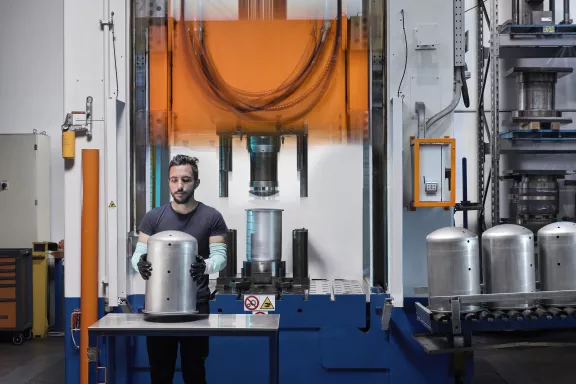
The sheet metal used to make them is worked mainly through deep drawing and cold forming, processes that produce hollow, strong shapes from a flat sheet, without the joints that could become a weak point in a component under pressure.
For this type of part, dimensional accuracy is not a detail: even a minimal error can compromise the component's sealing integrity or its service life, with direct consequences for safety as well as for the reliability of the machine.
Aesthetic Components: Covers, Body Panels, and Cup Warmer Grilles
Coffee machines, particularly professional models and those designed for high-end home interiors, are design objects before they are work tools. The metal covers that clad the machine body and the cup warmer grilles follow a different logic from functional components: here, the aesthetic result is a requirement as demanding as the technical one, if not more so, because every visible imperfection becomes a flaw in the eyes of the end customer.
For this reason, the choice and quality of the material for these components must be handled with great care. It is not enough for the sheet metal to be processed correctly: it must also look flawless.
Finishes: From Supermirror to Anti-Fingerprint Coatings
On the aesthetic components of coffee machines, Minifaber works stainless steel with precise finishes ranging from supermirror, the polished mirror finish that delivers maximum surface brilliance, to satin finishes of varying grades, more matte and less prone to visible marks, up to anti-fingerprint coatings, designed for frequently touched surfaces that must stay clean-looking even after daily use. These and other metal surface treatments are available for stainless steel, aluminum, and other materials.
The right finish depends on the role of the component and on the image the customer wants to convey: a supermirror finish communicates luxury and precision, a more matte satin finish favors understated looks and resistance to wear marks, and an anti-fingerprint coating solves a very practical daily maintenance problem.
Since a coffee machine is generally clad in several sheet metal parts, these must be absolutely identical, following the design of the machine. They must also be free of marks and scratches, and must show no processing shadows: for this reason, they must come from the same material coil.
A specialized team of operators inspects 100% of these body parts, step by step, in a perfectly lit environment and with all the necessary precautions to detect and remove any source of marks, scratches, and color alterations.
Why Stainless Steel Is the Material of Choice
Stainless steel is the material most often used in this sector. It resists corrosion, even with continuous exposure to water and steam, and remains stable over time. It is also compatible with all the high-end aesthetic finishes these components require.
It is a material that performs well on both the technical and the aesthetic side of the project, which makes it the most consistent choice when the same part, or the same family of parts, has to meet both requirements.
In addition, stainless steel sheet metal parts can be supplied with protective adhesive films. The thickness and adhesion of the film depend on the process the part must undergo: laser cutting, deep drawing, blanking, and others.
Manufacturing Processes: Transfer and Progressive Stamping, Capacitor Discharge Welding
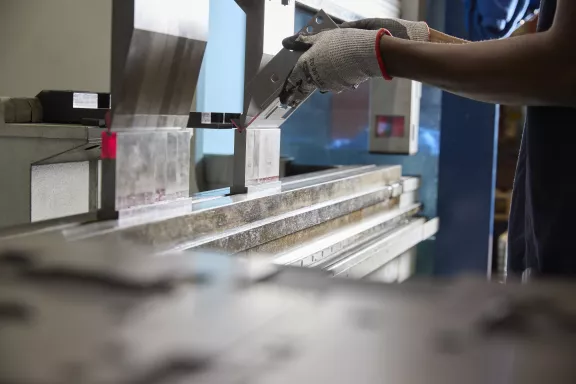
On the production side, coffee machine components are made mainly through transfer stamping and progressive stamping. These two metal stamping technologies perform multiple operations in sequence, often in a single machine cycle, achieving very high dimensional consistency from one part to the next. This is undoubtedly an essential requirement for medium to large production runs, where aesthetic repeatability matters as much as dimensional repeatability.
For component assembly, Minifaber uses capacitor discharge welding, a technique that releases the welding energy in an extremely short time. This limits the heat input to the part and, as a result, the risk of deformation or visible alterations on the surface, a decisive advantage when the weld involves components that remain visible or have already received their aesthetic finish.
Aesthetics and Repeatability: Two Non-Negotiable Requirements
Aesthetic quality and repeatability are the two parameters by which the coffee machine sector is measured, and both are required at very high standards. It is not enough to make one aesthetically perfect part: you must be able to repeat it, identical, across thousands of units.
Minifaber has already handled requests of this kind in other areas of kitchen robotics, as in the production of a bowl for a kitchen robot, where the customer's request went beyond the deep drawing of the part and included managing a complex product, assembling its components, and final testing: the same integrated approach that characterizes Minifaber's work on coffee machine components. You can see a related example in our coffee machine project.
Why Choose Minifaber for Sheet Metal Processing in the Coffee Machine Sector
Minifaber works with customers in the sector through a co-design approach, offering the technical and production expertise to follow the component from design to the finished product, whether it is a functional part such as a boiler or an aesthetic element such as a cover or a cup warmer grille. This approach identifies from the start the most suitable process, the right finish, and the production parameters needed to guarantee the same quality standard, part after part.