Progressive dies: characteristics, advantages, and applications in mass production

In the field of cold metal forming, progressive dies are undoubtedly one of the most efficient technological solutions for the mass production of high-precision metal components. This technology makes it possible to integrate multiple machining operations into a single continuous process, making it particularly suitable for industrial contexts where high volumes, precision, repeatability, and cost control are fundamental or even essential requirements. However, it should be emphasized that when we talk about progressive stamping, we are not referring to a standardized choice. In fact, it is necessary to start with a careful design of the die, which goes hand in hand with a thorough knowledge of the material to be processedand a careful evaluation of the geometry of the piece and its functional requirements.
What is meant by progressive stamping
Progressive stamping refers to a sheet metal working process in which a metal strip from a roll is progressively fed into a mold and the formed part is only detached from the mold at the end of the process. Within a progressive die, also known as a step die, numerous typical stamping operations can be performed:
- shearing
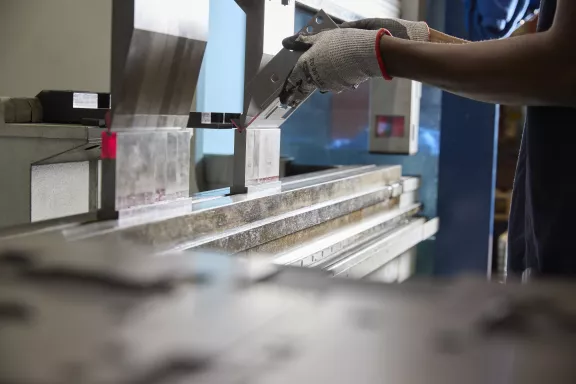
- bending,
- deep drawing,
- coining
- calibrating,
- threading
With each press stroke, each station/tool performs its own operation, while at the end of one stroke and before the next, the strip advances one step with great precision. The piece is thus formed progressively, with high productivity and dimensional repeatability. In fact, each press stroke produces a finished piece regardless of the number of operations performed and stations used.
The stages of the cold forming process
The cold forming process, which takes place at room temperature, is based on the controlled plastic deformation of the sheet metal through the combined action of the die and the press, without the need to heat the material. This results in precise geometries and high-quality surfaces without being altered by heating and its inevitable oxidation.
The stages of the process
The cold forming cycle at Minifaber consists of a sequence of integrated stages: Mold design This is the first strategic stage of the process. The in-house technical team develops the mold based on the customer's specifications, evaluating the geometry of the part, the material, production volumes, and functional requirements. The aim is to optimize the process at the virtual stage, preventing critical forming issues and ensuring production stability.
Mold construction
The mold construction phase is also fundamental. The mold is built in-house in a dedicated department, using high-precision 3- and 5-axis machine tools, EDM machines, and other advanced technologies. The choice of materials for mold construction is crucial. It determines the quality of the molded part, productivity, and the mold's durability. Conventional high-carbon alloy steels are used for mold construction, which must have high hardness and toughness characteristics.
Often, the choice falls on the highest-performing remelted or powder metallurgy steels, up to tungsten carbide hard metal.
Equally important is the heat treatment of these materials to further improve their characteristics, followed by polishing and, finally, PVD surface coatings, which not only increase surface hardness but also improve the coefficient of friction, anti-abrasion and anti-adhesion characteristics with the material to be processed, and resistance to chipping. This approach allows direct control over the quality, timing, and performance of the mold over time.
Selection and control of the material to be worked
The materials used to make the part are generally supplied in the form of strips in rolls from steel coil plants. Sheets, discs, or strips are used for single molds. Everything is carefully checked from a mechanical, chemical, and dimensional point of view, as the characteristics of the material directly influence its behavior during deformation and the quality of the final piece.
Cold stamping
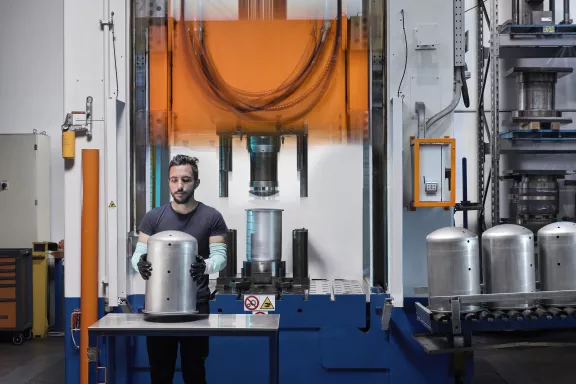
This phase is the heart of cold stamping. The material is deformed using a press, either mechanical or servo-driven, using carefully defined process parameters: force, speed, stroke, lubrication, and feed. The correct choice of lubricant and its dosage is essential to ensure surface quality, mold life, and process stability.
Finishing and subsequent treatments
When requested by the customer, the stamped parts can undergo further processing such as deburring, washing, galvanizing, painting, or other surface and/or heat treatments, depending on the application specifications.
Quality control
The entire production process is constantly monitored to ensure compliance with the technical specifications agreed upon with the customer.
Minifaber manufactures progressive dies for cold sheet metal stamping, which are particularly suitable for the mass production of high-precision metal components.
The advantages of progressive stamping in mass production
The use of progressive dies is particularly widespread in industrial contexts geared towards mass production, thanks to a number of technical and economic advantages.
High productivity and process continuity
Once started, progressive stamping allows for cycle continuity that reduces production times and makes the process particularly efficient for large volumes.
Reduced unit costs
Although there are initial costs for the design and construction of the die, in the subsequent phase the unit cost of the part is significantly reduced as the quantities produced increase. This makes progressive stamping a highly competitive solution in the medium to long term.
Consistent product quality
The guided sequence of operations and mechanical control of the process allow for consistent quality throughout production, reducing waste and rework.
Optimization of production phases
The integration of multiple operations within a single die eliminates intermediate steps, reducing handling, waiting times, and the risk of damage to semi-finished products. Furthermore, at Minifaber, the presses used for progressive dies are in line with tunnel washing systems and a subsequent packaging station. In this way, and in accordance with the principles of Lean Manufacturing, a finished piece emerges from the press-washing line from a roll of metal material, degreased, washed, and packaged, ready to be shipped to the customer's assembly lines.
Materials used in progressive dies
Progressive dies can be used with a wide range of materials, including:
- carbon steels and ferrous materials, including coated materials: pre-galvanized and pre-painted
- stainless steel
- aluminum and its alloys
- copper and copper alloys, such as brass and cupronickel.
As emphasized, choosing the ideal material is important, as this directly affects the design of the die. Correctly assessing the mechanical and chemical characteristics of the material is essential in the early stages of the project. It is equally important to check the incoming raw materials, which must meet the requirements specified in the order.
Industrial applications of progressive dies
Thanks to their efficiency and versatility, progressive dies are used in many industrial sectors, particularly where high volumes and consistent quality standards are required. The main areas of application include:
- electromechanical sector,
- household appliances,
- vending,
- professional lighting,
- robotics and automation,
- gas distribution.
In all these contexts, progressive stamping allows for the production of reliable, repeatable components that comply with the most stringent technical specifications.
When is progressive stamping the right choice?
Progressive stamping is particularly suitable when:
- production is intended for medium and large series,
- the component requires multiple integrated operations,
- high precision and dimensional repeatability are required,
- it is essential to optimize production times and costs,
- the process must be easily automatable.
For limited or prototype production, alternative solutions may be more suitable, such as single dies or other forming technologies to be evaluated together with the technical team.
Progressive dies and design: a strategic element
The effectiveness of progressive stamping depends largely on the design of the die. Accurate design allows you to:
- prevent critical issues in die operation,
- optimize the use of raw materials, reducing the cost of the manufactured part,
- increase the life of the die,
- increase the speed of the press and therefore hourly production
- ensure stability and continuity of production.
- Ensure the performance required by the customer in terms of quality and requirements over time
In this sense, the progressive mold is not only a production tool, but a real strategic lever for industrial efficiency.