Metallic component assembly: techniques and quality
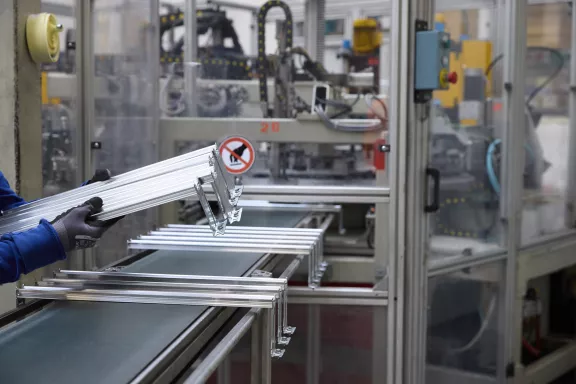
When it comes to industrial metalworking, it is a mistake to view the assembly of metal components as a mere finishing touch, to be added at the end of the process. In fact, this is a stage that requires precision, quality, and reliability.
The assembly phase of metal components is the stage where different parts are joined together to create a finished product or a subassembly, with the aim of ensuring functionality, stability, and structural strength in accordance with the required technical specifications.
This is a highly valuable service for the customer, who can find in Minifaber a single, reliable partner to manage the supply of assembled parts. This allows for the optimization of time and costs compared to managing multiple suppliers.
What is the assembly of metal components
In technical terms, assembly consists of the joining of multiple metal parts, in many cases even components made of different materials, to obtain a mechanically and functionally coherent whole. If requested by the customer, we can also assemble metal parts with non-metal parts such as plastics and resins.
This process may involve the use of various techniques such as welding or bonding, riveting and flanging, or reversible solutions such as screwing. This is an important distinction, because the type of assembly influences not only the product’s stability but also aspects such as maintenance, component replaceability, and overall design logic.
For this reason, discussing the assembly of metal components also means discussing the method. It is not enough to simply join the parts: it must be done in a manner consistent with the component’s end use, the required tolerances, and the operating conditions to which it will be subjected.
This is where assembly ceases to be a simple final operation and becomes a true phase of product engineering. For this reason, Minifaber integrates assembly with collaborative design, feasibility testing, and management of the entire process through to the final product.
The main metal assembly techniques
Assembly techniques can vary greatly, but in industrial settings, some are used more frequently than others. Welding is one of the most important when a permanent, stable, and strong joint is needed, capable of creating containers that are liquid- and gas-tight. Screw fastening, on the other hand, is used when it is necessary to maintain a certain degree of reversibility or when the component’s configuration requires it. Technical bonding can come into play in specific applications, such as when it is not possible to use the heat sources required for welding. Sometimes other fastening systems are used, such as riveting and crimping.
There are, therefore, permanent joints and reversible joints within the assembly process. The choice of the correct technique depends on concrete variables: material, thickness, shape of the part, required strength, production volumes, and expected final quality.
In an advanced industrial context, therefore, the starting point is not the “trendy” technology, but the component’s function and the production efficiency of the entire cycle.
The Role of Welding in Metal Assembly
When it comes to industrial metal assembly, welding plays a central role. This is, after all, one of the main processes in the mechanical engineering and metal fabrication industries, allowing for the permanent joining of two or more metal elements by fusing the edges of the parts in contact. This results in solid, durable joints capable of preserving the mechanical and functional characteristics of the metals used.
Welding is therefore one of the key technologies in integrated manufacturing. Minifaber performs welding on all metals, using various methods: MIG/MAG, TIG, resistance welding, projection welding, and laser welding.
Each of these processes can be performed manually, automatically, or even robotically.
The availability of different techniques allows us to choose the process best suited to the component being manufactured, avoiding standardized approaches that often compromise quality or efficiency.
When making a choice, it is helpful to know that TIG is associated with maximum precision and finish, MIG/MAG with high-volume automated production, resistance and projection welding with fast and repeatable joints, while laser welding stands out for its precision and minimal heat input. In addition, the company highlights the development of robotic welding, a key factor when aiming for repeatability, process control, and production continuity.
Assembly and Integrated Machining: Why Upstream Processes Make the Difference
The quality of an assembly is not determined solely at the moment the parts are joined. It is established earlier, in the machining processes that produce the individual components. Cutting, punching, and bending, as well as stamping and deep drawing, and even surface preparation such as cleaning and various finishes, all influence dimensional accuracy, fit, final geometry, and the stability of the subsequent assembly.
This is why assembly works exceptionally well when integrated into a seamless manufacturing process, where each stage is designed with the next in mind.
In the case of laser cutting, Minifaber guarantees speed, extreme precision, and versatility, as well as the ability to achieve clean finishes, reduce scrap, and perform complex machining on iron, steel, aluminum, other metals, and all of this has a direct impact on assembly: a well-cut component is easier to position, fit, and join with consistent quality. When the edge is precise and the geometry matches the design, the assembly and welding stages are also more stable and controllable.
The same logic applies to punching, which is one of the most in-demand processes on the market. At Minifaber, it is performed using state-of-the-art machinery and tailored to the material, sheet thickness, and shape to be produced. The ability to use the machine best suited to the specific application, combined with the know-how developed with international companies, reinforces the idea that the quality of the assembly also depends on the correct execution of the parts even before they are joined.
Bending is also a key part of our integrated manufacturing process. At Minifaber, this is one of the most common and precise processes for producing semi-finished or finished products, performed cold-forming based on the customer’s design and supported by advanced CNC machines. When the bend is executed with precision, the component arrives at the assembly stage with correct geometries, reducing positioning issues, unwanted stresses, and manual corrections during assembly.
The use of deep-drawn or hydroformed parts, on the other hand, is the most advantageous solution because it allows for a reduction in the number of components in assembled parts and in joining operations.
Quality in metal component assembly: what really matters
Quality in assembly is not merely about the parts “fitting together.” More accurately, it means achieving a consistent result in terms of design, required performance, durability, and production continuity.
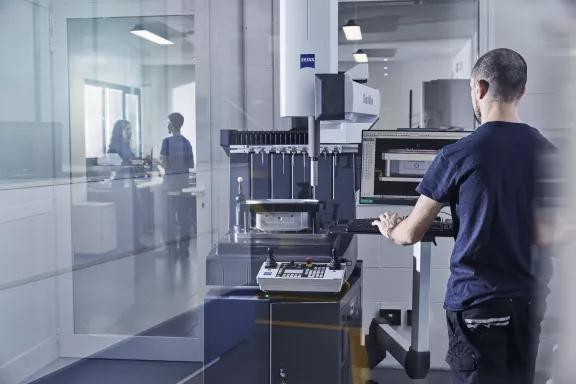
Quality assembly requires at least four conditions. The first is the dimensional accuracy of the components. The second is the correct choice of joining technique. The third is the repeatability of the process, especially when working with small and large quantities. The fourth is consistency between design, production, and testing.
How Minifaber works in the assembly of metal components
Minifaber’s approach is both consultative and industrial. Our specialized staff collaborates with the client on the design of the product and necessary components, conducts feasibility tests, implements the entire production process, and manages the logistics of the final product. This is a particularly significant step, as it clarifies that assembly is not viewed as an isolated activity, but as the final segment of a broader, well-managed technical process.
Added to this is a fleet of dedicated machinery and equipment. Minifaber uses custom-built machinery to ensure precision, efficiency, and quality at every stage of the process. The same focus on technology is evident in other processes: state-of-the-art punching machinery, CNC systems for bending and laser cutting, and the development of robotic welding.