CNC metal punch: how is it done?
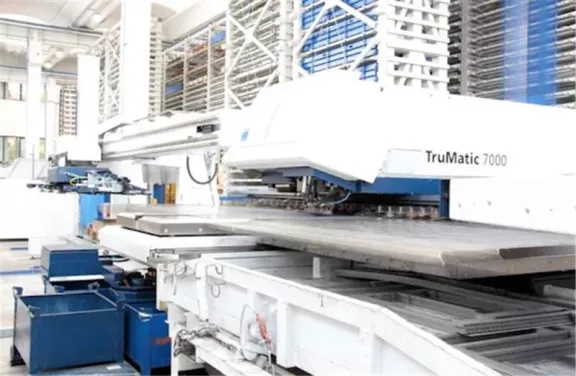
In sheet metal fabrication, CNC punching is one of the most widely used processes. It is employed above all to make holes, slots, shapes and cutouts, with the entire process controlled by numerically controlled machines.
What CNC Punching Is and How It Works
CNC punching is a process that locally deforms or removes material from a flat sheet, through the combined action of a punch and a die. The punch descends with vertical force, penetrating the material and pushing it into the die below: the result is a hole, a slot or a shape with clean edges, depending on the shape of the tool used.
What sets this technology apart from manual punching is the level of control. In the CNC version, the positioning of the sheet, the choice of tool and the sequence of punches do not depend on the operator's direct intervention but are managed by software that programs every single stroke with precision. The machines generally have tool turrets, on which standardized tools are mounted (punches, dies and hold-downs in standard or special shapes). These are selected automatically according to the set program, which is in turn built from the drawing of the component.
This makes it possible to produce different geometries on the same sheet, within the same production cycle and without manual tool changes: round holes, slots, custom shapes or complex grids.
On top of this comes the nesting program, which makes it possible to get the greatest possible number of parts out of a standard-size sheet, optimizing raw material consumption.
The Advantages of CNC Punching
The first advantage is production flexibility. Because the operations are programmed directly from the customer's drawing, any design changes translate into updates to the machine program, with no need to make a dedicated die.
This makes CNC punching particularly well suited to small and medium runs, to prototyping and to projects where the geometry of the component may still evolve.
The second advantage is precision: numerical control delivers tight tolerances and consistent repeatability from one part to the next, a fundamental requirement when components must be interchangeable or assembled with other parts.
The third is speed of execution on repetitive hole patterns: for holes and shapes that repeat many times on the same part, CNC punching is generally faster than a thermal cutting process such as laser, especially on large runs.
Finally, punching can also produce three-dimensional deformations in the sheet, such as embossing or countersinks, operations that a separation-cutting process cannot perform. There is also the possibility of threading with special tools, along with small bends.
CNC Punching by Material
The choice of punching parameters, in particular the clearance between punch and die, changes according to the material being processed and its thickness.
CNC Punching of Steel and Aluminum
Steel, and stainless steel in particular, requires greater punching force because of its higher mechanical strength, along with machines able to guarantee a clean cut while minimizing burrs, even on more demanding thicknesses. Minifaber offers CNC punching of steel and stainless steel with machines dedicated to this type of material.
Aluminum, by contrast, is a malleable material with lower mechanical strength than steel, which makes punching simpler in terms of the force required, but no less delicate. Precisely because of its malleability, an incorrect clearance between punch and die can produce burrs or unwanted deformation on the edges. Minifaber processes aluminum with CNC machines calibrated to achieve correct cuts even on complex geometries.
CNC Punching of Iron
Iron is among the most widely used materials in punching operations, including in pre-galvanized and pre-painted versions. This type of processing is in demand above all across a wide range of industries: from electromechanical to gas distribution, from vending to energy distribution, where punched iron components are widely used.
CNC Punching of Copper
Copper, like aluminum, is a malleable material that requires only limited punching force. This allows for meticulous, precise work, but demands particular care to avoid deformation and burrs on the punched edges of the part.
When to Choose CNC Punching
CNC punching is the most suitable solution when the component requires numerous holes, slots or shapes repeated on the same sheet, especially on medium-to-large runs where the speed of the process makes the difference in production times. It is also the most efficient choice when production volumes do not yet justify making a dedicated die, or when the project may change: updating the machine program is enough to adapt the job to a new revision of the drawing, without the cost and lead time of a new tooling setup.
When, on the other hand, production volumes are high, the geometry of the component is stable over time and maximum repeatability is required on very large runs, cold stamping with a dedicated die generally becomes the most cost-effective solution over the long term.
Minifaber's Machine Fleet for CNC Punching
Over the years, Minifaber has been chosen by numerous domestic and international companies for sheet metal fabrication, including CNC punching. Thanks to an up-to-date machine fleet and a team that keeps constantly abreast of developments in the industry, Minifaber performs punching operations on a wide selection of metals, meeting any hole-making or shaping need for sheet metal. At Minifaber, we use machines in which punching technology is combined with laser cutting. This lets us draw on the advantages of both processes together: the precision and speed of punching with the flexibility of laser cutting. A winning combination in terms of cost and quality.