Metal bending: techniques, machinery, and precision in sheet metal fabrication
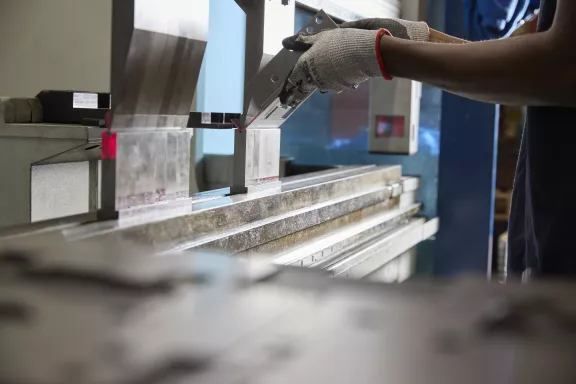
Metal bending is one of the most common yet precise processes in sheet metal fabrication. Through a cold-forming process, it enables the production of panels, semi-finished products, and finished components from flat sheets of metal, in accordance with the technical drawings provided by the customer.
At Minifaber, metal bending represents a expertise honed over time. Since 1960, the company has been active in cold metal forming, gaining over a decade of experience in steel bending, aluminum bending, and the processing of stainless steel, ferrous materials, and copper for applications across various industrial sectors.
The metal bending process at Minifaber
Sheet metal bending at Minifaber is not a simple mechanical operation, but a process that begins with analyzing the project together with the customer. Once the specific requirements and the final application of the part are understood, the most suitable bending strategy is defined and the appropriate machine is selected to ensure the desired result.
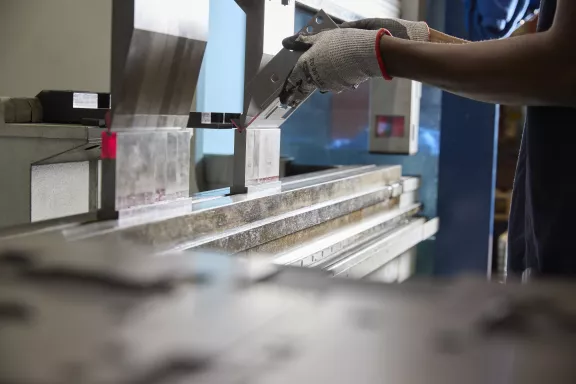
The work is carried out using technologically advanced, CNC-programmable bending and panel bending machines. CNC bending allows for precise control of angles, sequences, and deformation parameters, ensuring consistency between the technical drawing and the manufactured component.
The machine fleet dedicated to metal bending includes 7 state-of-the-art bending machines and one panel bender. The bending machines can exert a force ranging from 30 to 180 tons and work with blades and dies up to 3123 mm in length. Each machine is equipped with 7-axis control, a feature that contributes to the precision of the bend and the repeatability of the process.
Bending techniques: air bending, coining, and flattening
Metal bending can be performed in various ways, depending on the characteristics of the part and the desired result.
In air bending, the sheet metal is supported at two points on the V-die and deformed by the punch, which does not reach the bottom of the die cavity. This technique allows for the control of the material’s natural elastic recovery, known as springback, the extent of which depends on the nature of the metal, its hardness, and its elasticity, as well as its thickness
With coining, however, the punch reaches the bottom of the die cavity. In this way, the bend angle is consistently replicated across all produced parts.
The flanging technique is used to eliminate sharp edges on the workpiece, creating a double-thickness, radiused edge on the sheet metal.
The use of programmable press brakes allows for control of springback and ensures metal bending that meets the project’s specifications.
The panel bender for complex bends
Bending using a panel bender is particularly suitable for components that must be bent on all four sides, with complex and varied bends.
During the process, the sheet metal is placed on a work surface and clamped by the machine’s sheet metal clamp, while a dedicated tool performs the bend on the part. This technology allows for the precise and continuous execution of complex operations.
Bending of steel, aluminum, and other metals
Metal bending at Minifaber covers various types of materials, including:
- stainless steel
- ferrous materials
- aluminum and its alloys
- copper and its alloys
Each material has specific characteristics that influence its behavior during bending. For this reason, the choice of machine and processing strategy is based on the project and the properties of the metal to be processed.
Our expertise in steel bending and aluminum bending allows us to meet the needs of various industrial sectors while ensuring consistency with the technical design and application requirements.
Application sectors for metal bending
The sheet metal bending service is aimed at numerous industrial sectors, including:
- electromechanical
- home appliances and kitchen robotics
- vending
- professional lighting
- medical
- EV chargers
- gas distribution
The versatility of the process allows us to handle both small quantities and larger production runs, always starting from a technical analysis shared with the customer.
Metal bending integrated into cold forming
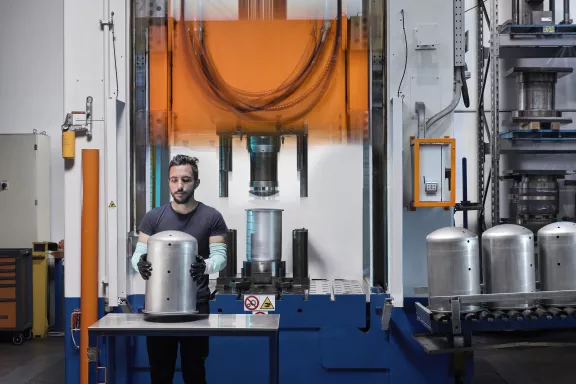
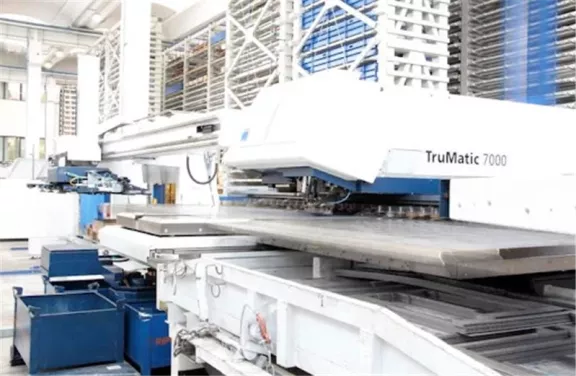
Bending is one of the cold metal forming processes that Minifaber performs alongside blanking, deep drawing, hydroforming, punching, 2D and 3D laser cutting, welding, and assembly. This integration allows us to offer a complete sheet metal fabrication service, from the initial phase through to the finished component.
Minifaber offers professional metal bending services for both small and large quantities, utilizing advanced CNC machines and a dedicated fleet of equipment.