Laser cutting and related technologies: fiber, CO₂, advantages and applications
Cutting is one of the main stages in industrial sheet metal processing. It has a direct impact on component quality, production times, and the efficiency of subsequent operations.
Today, laser cutting of metals is recognized as one of the most widely adopted technologies in the sector. It combines precision, speed, and versatility, enabling the engraving, cutting, and shaping of sheet metal according to highly accurate technical specifications.
This technology is often used in the production of semi-finished metal products and components, as it ensures clean finishes, reduces scrap, and enables complex machining on iron, steel, aluminum, and other metals.
What is laser cutting of metals and how does it work?
Laser cutting of metals is based on the use of a high-intensity laser beam that strikes the metal surface and locally heats the material until it melts.
The metal is then separated in a controlled manner along the geometry set by the operator through computer numerical control systems. This allows the technical drawing to be followed with great accuracy, producing even complex shapes with a very high level of precision.
From an industrial standpoint, laser cutting is widely used in sheet metal fabrication and in the production of semi-finished products and components made of steel, aluminum, copper, and other metals.
Why laser cutting is so widely used in sheet metal fabrication
The growing importance of laser cutting is due to its ability to combine precision and flexibility.
This technology makes it possible to create virtually any geometry on sheet metal while leaving an extremely clean cut edge. Speed of execution, versatility across different materials, and reduced scrap further add to its value: all decisive factors in industrial production, where quality, efficiency, and cost control must be balanced.
It should also be noted that sheet metal laser cutting machines are not subject to wear in the same way as other machining systems, which results in minimal maintenance requirements.
This means relying on dependable technology capable of supporting repeatable and continuous machining operations.
Fiber laser cutting: characteristics and applications
In general terms, the fiber laser is one of the major developments in laser cutting technologies applied to metals. Simply put, it is a system in which the laser beam generated by a source is transmitted through an optical fiber to a lens system - the laser head - which focuses the beam onto the workpiece to be cut.
Compared with other cutting technologies, fiber laser cutting, thanks to its short wavelength, can cut even highly reflective metals such as brass and copper, while also providing fast, precise processing suitable for metals such as iron, steel, stainless steel, and aluminum.
CO₂ laser cutting: a historic thermal cutting technology
CO₂ laser cutting is one of the historic technologies in industrial laser cutting. Its name derives from the active medium used to generate the laser beam.
Compared with fiber lasers, CO₂ lasers belong to the same technological family but differ in terms of system architecture and fields of application.
Both technologies fall within the scope of laser cutting: a process that separates metal using concentrated energy and numerical control.
Plasma cutting: a related but not equivalent technology
Plasma cutting is often mentioned among the technologies related to laser cutting. In general terms, it is a different process that uses a jet of high-temperature ionized gas to separate the metal. It is therefore correct to define it as a related industrial technology, but not as an equivalent one in terms of operating principle.
In general comparison, laser cutting is superior in terms of precision, edge cleanliness, and the ability to create complex geometries, although it has limitations in terms of material thickness. Plasma cutting, by contrast, is used on thicker sheets. Moreover, the plasma-cut edge is rough and oxidized and often requires subsequent machining.
Waterjet cutting is also used for metals and is particularly suitable for high thicknesses. It produces an accurate, high-precision cut, although its low cutting speed must be taken into account.
The concrete advantages of laser metal cutting
The main advantages of laser cutting are numerous. The first is high precision, which allows for complex geometries and clean edges. The second is versatility, as the process can be applied to different metals. The third is speed, which translates into greater operational efficiency. The fourth is reduced scrap, an important factor both economically and in terms of production process optimization.
In addition to these factors, laser cutting uses a cutting gas to expel molten material from the cutting zone, ensure clean edges, cool the workpiece to prevent thermal deformation, and protect the focusing lens from fumes and spatter. Two gases are generally used: nitrogen, an inert gas, and oxygen, which triggers an exothermic reaction. Nitrogen can be used for all metals and produces a clean, oxidation-free cut. Oxygen is used only for iron: it creates a combustion reaction that facilitates cut penetration and increases cutting speed.
This clearly shows that laser cutting is a precise technology, but also one that can be technically adapted according to the material and the machining objective.
Laser cutting of stainless steel sheet metal and other metals
Laser cutting is well suited to the processing of various metals, including iron, stainless steel, aluminum, and copper. This makes the process particularly attractive for companies managing diversified production, for components intended for different application sectors, and more generally for specialized partner companies.
In the case of stainless steel sheet cutting, precision and edge cleanliness are especially important because they can affect the final quality of the component and the need for any rework.
More generally, when working with semi-finished metal products intended for demanding industries, the quality of the initial cut becomes a critical factor for the entire downstream process.
The role of design in laser metal cutting
At Minifaber, laser cutting is part of a broader technical process. The use of precision laser cutting is defined as early as the design phase, with the Technical Department working closely with the customer. Only then does the actual cutting of the sheet metal proceed, using advanced machinery.
This step is also very important from an industrial standpoint: the quality of the result depends not only on the machine, but also on the consistency between the design, material, intended use, and chosen technology. In other words, the value of laser cutting increases when it is integrated into a technical process that begins with component analysis and leads to production based on precision and repeatability criteria.
How Minifaber approaches sheet metal laser cutting
Minifaber takes a very specific approach to sheet metal laser cutting, combining dedicated technologies, technical expertise, and close collaboration with the customer.
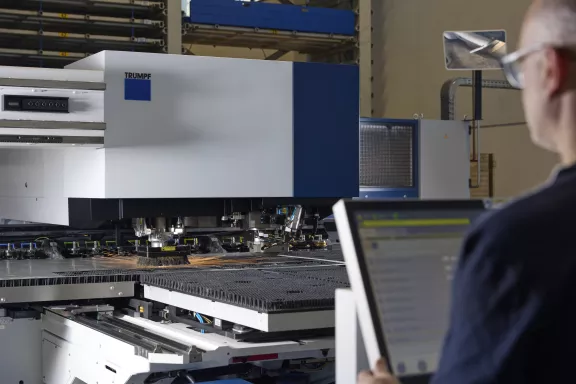
Our company supports customer projects with a comprehensive, highly specialized machine fleet. We have four combined laser punching machines that bring together the advantages of both operations and can cut sheet metal up to 6 mm thick.
This is complemented by a deburring machine, which removes any residual imperfections.
The production process continues with nine press brakes, which give the laser-cut part the final shape required by the technical drawing. To complete the process, we provide presses and equipment dedicated to riveting and crimping for the insertion of components such as nuts, screws, pins, and bushings.
Through this integration of technologies and expertise, we are able to offer not only individual components but also ready-to-use assembled solutions, optimizing time, costs, and quality for the customer.
Thanks to a technologically advanced in-house welding department equipped with all major processes, we provide customers with complex turnkey assemblies. This integrated solution optimizes the supply chain and significantly reduces handling times and logistics costs.
When to choose a partner specialized in laser cutting
To choose the most suitable cutting technology, it is not enough to compare fiber, CO₂, and plasma lasers in the abstract. The starting point must be the component itself: material, thickness, tolerances, geometric complexity, quantity, required finish, and subsequent processing.
This is precisely why the support of a specialized technical partner makes all the difference, especially when the project requires not only the cutting operation itself, but a comprehensive assessment of the entire production workflow.
Minifaber also offers added value through the combination of sheet metal processing, advanced technologies, and technical consulting from the design phase onward. Our approach turns metal laser cutting into a concrete lever for precision, efficiency, and industrial quality.